
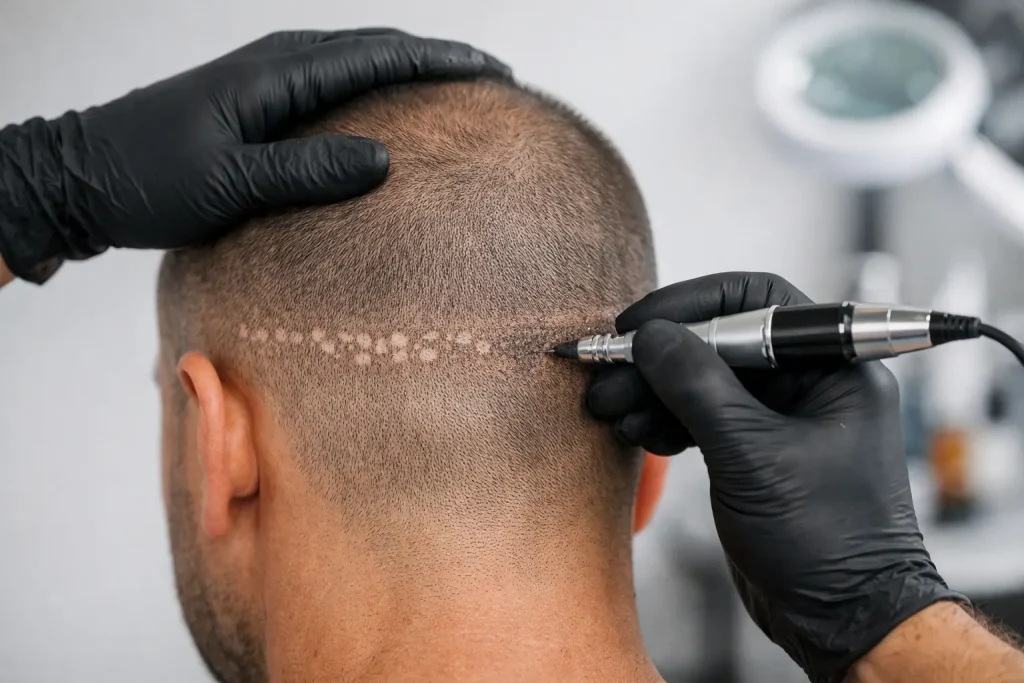
You notice it most under bright light, after a fresh haircut, or when someone stands just a little too close. FUE scar camouflage treatment is designed for exactly that moment – when tiny dot scars from a hair transplant still show through and keep you from feeling fully at ease with your look.
For many people, FUE was supposed to be the less noticeable transplant option. In many cases, it is. But “less visible” does not always mean invisible. Donor area overharvesting, lighter skin contrasted against dark hair, short hairstyles, and uneven healing can all make those circular extraction marks stand out more than expected. That is where scalp micropigmentation can make a real difference.
What FUE scar camouflage treatment actually does
FUE scar camouflage treatment uses scalp micropigmentation, or SMP, to reduce the contrast between transplant scars and the surrounding hair-bearing scalp. Rather than trying to change the skin itself, the treatment places carefully matched pigment impressions into the area so the eye reads the donor zone more evenly.
This matters because scar visibility is usually a contrast problem. When the scar tissue reflects light differently or lacks the visual texture of nearby follicles, it becomes noticeable. A skilled SMP artist addresses that by replicating the appearance of natural follicle shadow with the right size, depth, spacing, and shade.
Done properly, the result should not look like a tattoo. It should simply make the donor area look cleaner, softer, and far less distracting. The goal is not to pretend the skin was never altered. The goal is to make the scar blend so well that it no longer dominates your appearance.
Why FUE scars can still be visible
FUE leaves hundreds or even thousands of tiny extraction points in the donor area. While each mark is small, the cumulative visual effect can become obvious, especially when the procedure is aggressive or the healing response is less than ideal.
Some clients have scattered white dots. Others have patchy thinning where too many grafts were taken from one zone. In those cases, the issue is not only the scar itself but also the loss of density around it. That distinction matters, because the best treatment plan may need to address both the scar pattern and the surrounding scalp appearance.
Skin tone also plays a role. Lighter scars against darker skin can show clearly, while darker post-inflammatory changes can be visible on lighter complexions. Hair length matters too. The shorter you wear the back and sides, the more exposed the donor area becomes.
Who is a good candidate for FUE scar camouflage treatment
The strongest candidates are people with healed FUE donor scars who want to wear their hair shorter, reduce visible scarring, or improve the overall appearance of an overharvested donor area. It can work well for men who keep a close fade, women with short hairstyles, and transplant patients who simply want the back and sides to look more uniform.
Timing is important. The donor area should be fully healed before treatment begins. If the skin is still pink, inflamed, or actively remodeling, it is too early. In most cases, waiting until the transplant scars have matured gives the best chance for stable and predictable results.
There are also cases where expectations need to be realistic. If the donor area has severe texture change, significant pitting, or very large areas of depleted density, SMP can improve the look dramatically, but it may not erase every sign of prior surgery. The best artists are honest about that. Precision matters, but so does proper case selection.
How the treatment process works
At a high level, FUE scar camouflage treatment is a layering process. The first session establishes the foundation. The second and third sessions refine density, balance, and realism. Building the result gradually is one of the reasons top-tier SMP looks natural rather than flat or overdone.
The artist first evaluates scar size, color, pattern, surrounding hair density, and your usual haircut length. Pigment choice is not guesswork. It has to be selected in relation to your skin tone, existing follicle appearance, and the way the donor area will look once healed.
During treatment, tiny pigment deposits are placed with precision to mimic the look of shaved follicles. Scar tissue often behaves differently from normal skin, so technique has to adapt. Depth, pressure, and spacing cannot be copied blindly from standard SMP work. This is where specialist experience matters.
After each session, the area settles and the result softens. Additional sessions allow the artist to adjust based on how your skin retains pigment. That controlled approach is one of the biggest reasons scar camouflage can look so convincing when performed by the right practitioner.
FUE scar camouflage treatment versus more surgery
For clients frustrated by visible donor scarring, surgery is not always the next best answer. In fact, more surgery can sometimes create more complexity. Additional grafting into scarred areas may help in certain cases, but it depends on blood supply, tissue quality, available donor reserves, and realistic density expectations.
SMP offers a non-surgical solution. There is no cutting, no graft extraction, and no long healing cycle. The visual improvement is also immediate once the sessions are complete. That makes it appealing for people who are done chasing surgical fixes and want a cosmetic solution that restores confidence fast.
That said, it is not a replacement for every medical option. If someone expects actual hair regrowth, SMP is not that. It creates the look of density and follicle presence. For many people, especially those focused on appearance rather than biological regrowth, that distinction is perfectly acceptable. For others, it is part of a broader restoration plan.
What natural results depend on
The difference between believable scar camouflage and obvious cosmetic work comes down to detail. Scar tissue is less forgiving than untouched scalp. If the impressions are too dark, too large, too uniform, or poorly positioned, the treatment can become noticeable for the wrong reasons.
Natural results rely on restraint. The pigment has to sit in harmony with the surrounding area, not overpower it. Matching the donor zone is different from creating a frontal hairline, and an experienced SMP practitioner understands that the eye reads these areas differently.
This is one reason clients often travel for scar work. They are not just paying for pigment placement. They are paying for judgment, technical control, and the ability to create an undetectable finish in one of the most challenging categories of SMP. At RK Scalp Micropigmentation, that standard of realism is the benchmark, not the bonus.
Recovery, maintenance, and what to expect
Most clients find the recovery straightforward. The area may appear slightly darker right after a session, then soften as it heals. Aftercare matters because proper healing protects both the quality of the result and the longevity of the treatment.
Long term, some maintenance is normal. SMP is low maintenance compared with surgery, but not no maintenance. Over time, subtle refresh sessions may be needed depending on skin type, sun exposure, lifestyle, and how crisp you want the camouflage to remain.
The encouraging part is that you are not locked into a complicated routine. Once the series is complete, most people simply enjoy the freedom of not thinking about the scar every time they get a haircut or see the back of their head in a mirror.
The emotional side of donor scar correction
People often downplay how much donor scarring affects them. It is easy to say, “It’s only the back of my head.” But if it changes the way you cut your hair, the way you sit under harsh lighting, or the way you feel in close social settings, it is not small.
FUE scar camouflage treatment is not about vanity in the shallow sense. It is about removing a detail that keeps pulling your attention back to a procedure you hoped would solve a problem, not leave a new one behind. When the donor area finally looks consistent, people tend to carry themselves differently. They stop managing around the scar and start feeling like themselves again.
That is why this treatment matters. Not because it chases perfection, but because it restores control. If your transplant scars are healed and still visible, the right camouflage work can give you a cleaner result, more flexibility with your hairstyle, and one less thing to think about every day.