
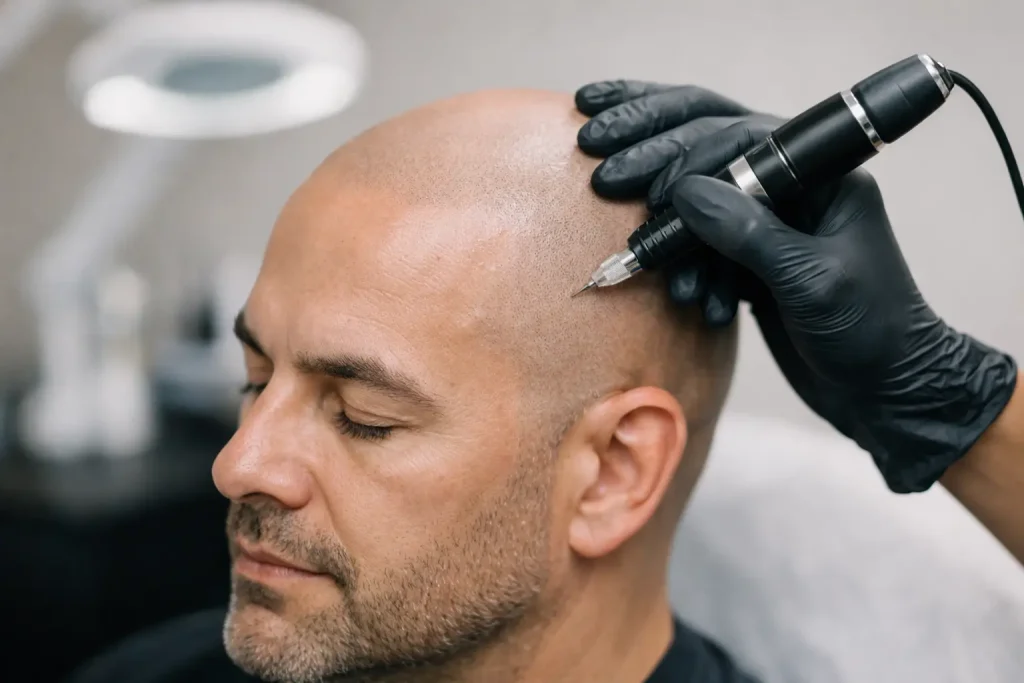
The question most people ask quietly – sometimes after they have looked at dozens of before-and-after photos – is simple: is SMP painful?
It is a fair question. If you are considering scalp micropigmentation, you are already thinking about how it will look, how natural it will be, and whether it will actually restore confidence. But before any of that, most clients want to know what the experience feels like in the chair. The honest answer is this: SMP is usually very manageable, and most people find it far less painful than they expected.
Is SMP painful for most people?
For most clients, scalp micropigmentation feels more like irritation than intense pain. Some describe it as a light scratching sensation. Others compare it to mild discomfort during certain parts of the session, especially in areas where the scalp is more sensitive. It is not typically described as severe.
That matters because many people come in expecting something much harsher. They hear the word pigment, think of tattooing, and assume the pain level will be the same as a traditional body tattoo. In reality, SMP is different in both technique and depth. The process is highly controlled, the impressions are placed much more superficially than a standard tattoo, and the goal is precision and realism – not deep, heavy saturation.
The result is a treatment that is generally tolerated very well, even by clients who were nervous going in.
Why SMP usually feels easier than a regular tattoo
A lot of the fear around discomfort comes from comparing SMP to tattoo work on the arm, chest, or ribs. That comparison is understandable, but it is not exact.
Scalp micropigmentation uses specialized equipment and methods designed specifically for the scalp. The treatment is focused on creating tiny follicle impressions that replicate natural hair stubble or density, depending on the case. Because the work is cosmetic and detail-driven, an experienced artist approaches the scalp with a very different hand than a traditional tattoo artist.
There is also a psychological difference. Many SMP clients come in expecting the worst, then realize within the first part of the session that the feeling is tolerable. Once that tension drops, the entire experience tends to feel easier.
That said, comfort is not identical for everyone. Some sessions feel easier than others, and some scalp zones are more sensitive.
What affects how painful SMP feels?
Pain tolerance is personal, but a few things consistently influence how the treatment feels.
Your scalp sensitivity
Some people naturally have more sensitive skin. If your scalp reacts easily to shaving, sun exposure, or cosmetic products, you may notice more discomfort during treatment. That does not mean SMP will be hard to get through. It just means you may feel it a little more than someone with less reactive skin.
The treatment area
Not every part of the scalp feels the same. Hairlines and temple areas can sometimes feel more noticeable because the skin there may be slightly more sensitive. Scar camouflage can also be different, especially if the tissue is uneven or has changed after surgery. Density treatments for thinning hair may feel different from a full shaved-head simulation because the work pattern and target areas are different.
Session length
SMP is usually completed over multiple sessions rather than all at once. That structure helps create a more natural result, but it also helps with comfort. A shorter, controlled session is easier for most clients than trying to force too much treatment into one appointment. As the session goes on, you may become more aware of the sensation simply because you have been sitting through it for a while.
Your stress level before the appointment
If you walk in tense, underslept, over-caffeinated, and expecting pain, the treatment can feel more intense. Anxiety makes people focus on every sensation. Clients who come in rested, hydrated, and mentally prepared usually handle the process much better.
What does SMP pain actually feel like?
This is where clear expectations help. Most clients do not describe SMP as sharp, unbearable pain. More often, they call it annoying, mildly uncomfortable, or surprisingly easy. The feeling tends to come in as a repetitive surface-level sensation rather than a deep or dramatic one.
The closest description for many people is a fast scratching or light prickling feeling across the scalp. In some spots, you may barely notice it. In more sensitive zones, you may feel a stronger sting for short periods. But the discomfort usually stays at a level clients can manage without much trouble.
That is one reason so many people who were hesitant at first go on to complete all three sessions confidently. The anticipation is often worse than the treatment itself.
Is SMP painful during every session?
Not always in the same way. The first session is often the one clients worry about most because everything is new. Once they understand the sensation, the next appointments usually feel more predictable and mentally easier.
Some clients say later sessions feel lighter because they are more relaxed. Others notice certain appointments feel a bit more sensitive depending on skin condition, how recently they shaved, or how much work is being done in one area. There is no universal rule, but the overall pattern is that SMP remains very manageable across the full treatment plan.
A skilled practitioner also knows how to work efficiently and consistently, which matters. Precision affects more than the final result. It also affects how controlled and comfortable the process feels in real time.
Can numbing be used?
Some clinics use numbing products, while others rely on technique and client tolerance. Whether numbing is appropriate depends on the artist, the product being considered, and the client’s skin. The better question is not just whether numbing exists, but whether it supports the quality of the treatment.
In elite SMP work, the priority is always the result. If a comfort measure interferes with how the skin behaves or how the pigment is placed, that trade-off needs to be considered carefully. This is one reason experience matters. You want someone who understands both client comfort and the technical demands of natural-looking follicle replication.
How to make SMP more comfortable
You do not need to overthink this, but a few simple choices can make a real difference. Show up well rested. Eat beforehand. Stay hydrated. Avoid heavy alcohol intake the night before, and do not arrive in a rushed, anxious state if you can help it.
It also helps to communicate. If something feels unusually sensitive, say so. A true professional is not guessing their way through the appointment. They are paying attention to your skin, your comfort, and the overall pace of the session.
At RK Scalp Micropigmentation, that level of control is part of what separates premium treatment from average work. Clients are not just paying for pigment placement. They are trusting the process, the precision, and the ability to produce realistic results without unnecessary trauma to the scalp.
Pain should never be the only question
It is smart to ask, is SMP painful, but it should not be the only thing guiding your decision. The bigger issue is whether the treatment is being done correctly.
Poor technique can create more discomfort, more skin stress, and worse cosmetic outcomes. An artist with limited experience may work too aggressively, use the wrong depth, or fail to adapt to different scalp conditions. That can affect both how the session feels and how the healed result looks.
When you choose a proven specialist, you are not just reducing uncertainty around pain. You are increasing the chance of a result that looks clean, subtle, and undetectable in the real world. That is the standard that actually changes confidence.
The real answer to is SMP painful
For most people, SMP is not pain-free, but it is absolutely manageable. That is the most honest answer. You will likely feel some level of discomfort, especially in certain areas, but it is usually mild enough that clients complete treatment without any major issue.
If you have been holding back because you imagined something extreme, you are probably overestimating it. Most people leave their first session saying the same thing: it was nowhere near as bad as they thought.
And when the work is done at a high level, the short-term discomfort is not what stays with you. What stays with you is the feeling of looking in the mirror and seeing a stronger, cleaner, more confident version of yourself looking back.