
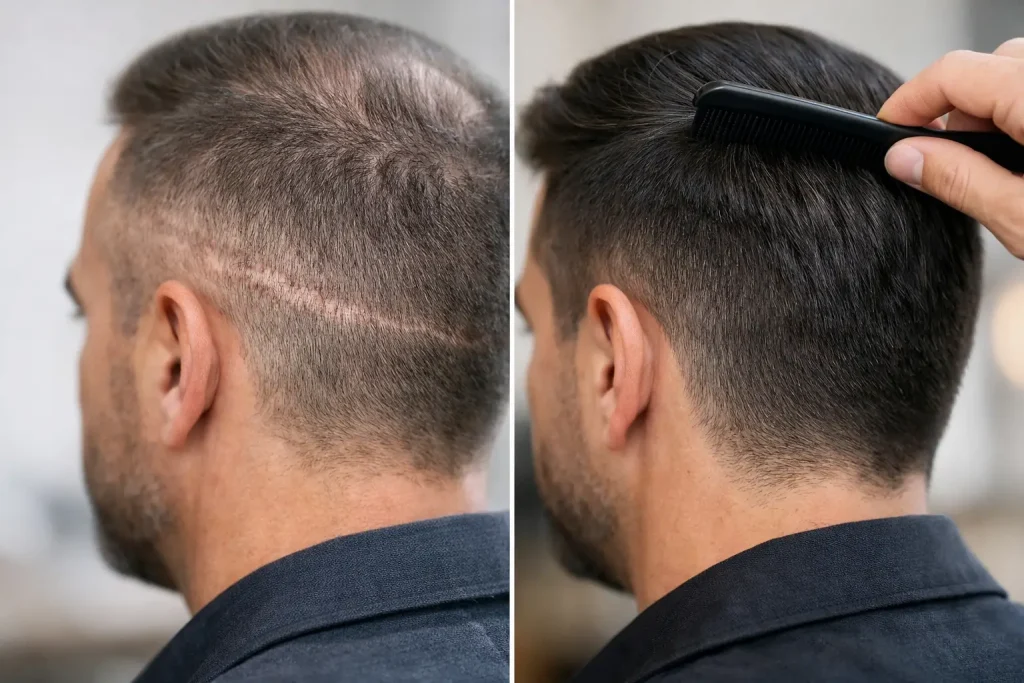
The moment a transplant scar starts showing through a short haircut, the issue stops feeling minor. It becomes something you check in mirrors, think about in bright lighting, and try to hide in photos. If you are searching for how to camouflage hair transplant scars, the good news is that there are effective options – but the right one depends on your scar type, hairstyle goals, and how natural you want the result to look up close.
How to camouflage hair transplant scars without guesswork
Not all transplant scars behave the same way. A linear FUT scar at the back of the head creates a very different challenge than scattered FUE dot scars across the donor area. Some scars are flat and pale. Others are raised, widened, uneven in color, or resistant to growing hair through the tissue. That matters, because the best camouflage method for one person can be the wrong move for someone else.
The biggest mistake people make is assuming they only need more hair. In reality, scar visibility is often about contrast. When the scalp or scar tissue is lighter than the surrounding hair, or when hair density around the donor area has been overharvested, the eye goes straight to the mismatch. Effective camouflage reduces that contrast and restores a believable overall appearance.
Why hair transplant scars become visible
A transplant scar usually stands out for one or more reasons. The scar tissue may not grow hair at all, which leaves a blank area against surrounding stubble or hair. The texture can also reflect light differently, especially if the scar is smooth, shiny, or slightly raised. In FUE cases, the issue is often not one obvious scar, but a patchy donor zone that looks thinner than it should when the hair is cut short.
This is why some people look fine with longer hair but feel exposed as soon as they go to a fade or a close buzz cut. Hair length can hide a lot, but it does not fix the underlying visual disruption.
The most effective option for many people: scalp micropigmentation
For many clients, scalp micropigmentation is the most reliable answer to how to camouflage hair transplant scars. SMP works by placing tiny pigment impressions into the scalp to replicate the look of natural hair follicles. When performed with precision, it can break up the visibility of a linear FUT scar, soften the appearance of FUE extraction marks, and reduce the contrast between scar tissue and the surrounding donor area.
The reason SMP works so well is simple. It does not rely on scar tissue producing hair. Instead, it creates the visual impression of density where the eye expects to see it. That makes it especially valuable for people who want to wear their hair shorter or who have already tried growing it out and still feel limited.
A strong scar camouflage result is not just about adding pigment into the scar itself. The surrounding area often needs to be blended too. This is where elite-level work separates itself from average work. If the artist only darkens the scar without accounting for neighboring density, tone, and haircut length, the result can still look obvious. The goal is not to make the scar disappear in theory. The goal is to make it unnoticeable in real life.
FUT scar camouflage vs. FUE scar camouflage
FUT scars and FUE scars require different treatment approaches.
FUT scars
A FUT scar is usually a line across the back of the scalp. Some are thin and easy to blend. Others are stretched, uneven, or raised. With FUT scar camouflage, SMP can soften that line by recreating follicle impressions through and around the scar. If the scar is flat and the surrounding donor hair is reasonably strong, results can be excellent.
If the scar is very raised or shiny, expectations need to be realistic. SMP can reduce contrast dramatically, but it may not fully correct a texture issue. In those cases, combining SMP with another scar treatment may produce the best outcome.
FUE scars
FUE scarring often shows up as widespread white dots or an overharvested donor area. This is less about one scar and more about an unnatural see-through effect when the hair is cut short. SMP is particularly effective here because it can rebuild the look of density across the entire donor zone. Rather than trying to hide one mark, it restores visual balance to the back and sides of the head.
That can be life-changing for people who thought their only option was to keep their hair longer forever.
Other ways to camouflage hair transplant scars
SMP is often the strongest cosmetic solution, but it is not the only option.
Growing the hair longer is the most obvious fix. It can work well for some people, especially with a narrow FUT scar. The drawback is that it limits your hairstyle choices. You are not really solving the issue – you are managing it.
A hair transplant into the scar is another possibility. Some surgeons place grafts into FUT scars to reduce visibility. Results vary. Scar tissue has a different blood supply than healthy scalp, so graft survival can be less predictable. It may help, but it rarely gives the same consistency as healthy native growth.
Scar revision surgery is sometimes recommended for wide or poorly healed FUT scars. This can improve the shape or width of the scar, but it is still another surgical procedure, with another healing period and no guarantee of an ideal final appearance.
Topical concealers and hair fibers can help in specific situations, but they are temporary. Sweat, rain, bright light, and close contact can make them feel unreliable. For someone who wants lasting confidence, they are usually a short-term workaround rather than a real answer.
Who is a strong candidate for scar camouflage?
The best candidates are people with healed transplant scars who want more freedom with their hairstyle and less stress about visibility. That includes men and women with FUT strip scars, FUE dot scarring, donor depletion, or failed transplant work that left the back of the scalp looking unnatural.
The scar should be fully healed before any SMP treatment. If the area is still red, unstable, or actively changing, it is too early. A proper assessment also looks at skin tone, scar texture, current hair length, and whether you want to keep a shaved or closely cropped style long term.
That last point matters. The ideal pigment density for someone who keeps a zero guard is different from someone who wears more length through the back and sides. Precision comes from designing the result around your real lifestyle, not a generic template.
What makes scar camouflage look natural
Natural results come down to restraint, pattern, and blending. The pigment has to match the surrounding follicle scale and sit correctly within the broader density pattern of the scalp. Scar tissue can also hold pigment differently than normal skin, which means experience matters.
This is not an area where you want guesswork. A scar may need multiple sessions to build the right softness and depth. Going too dark too fast is one of the fastest ways to create an unnatural result. High-level practitioners understand how to layer the treatment so the camouflage looks believable from every angle, under real lighting, and at your chosen hair length.
That is why specialized scar work matters. Camouflaging transplant scars is not the same as standard SMP on a clean scalp. It requires a more controlled eye, stronger technical judgment, and a clear understanding of how scar tissue behaves.
What to expect from the process
Most SMP scar camouflage is completed over a series of sessions. That allows the artist to assess how the scar retains pigment and refine the blend gradually. The first session usually establishes the base impression. Later sessions add density, adjust tone, and bring the scar into better harmony with the surrounding area.
You may still notice the scar if you shave completely to the skin or inspect it at extreme close range. A good practitioner will be honest about that. The real standard is whether the scar stops drawing attention in normal daily life. For most clients, that is the result that restores confidence.
For those seeking elite-level work, a specialist clinic such as RK Scalp Micropigmentation can assess whether SMP alone is enough or whether a combined approach makes more sense.
Choosing the right solution for your goals
If your only goal is to make the scar a little less obvious with longer hair, a styling change may be enough. If you want the freedom to wear your hair short again, SMP is often the strongest option. If your scar is raised, widened, or surgically poor in appearance, a combined strategy may be worth considering.
The key is choosing a solution based on outcome, not hope. Hair transplant scars can be camouflaged extremely well, but the best results come from accurate assessment and expert execution, not from chasing the next quick fix.
A visible scar can make you feel boxed in, but it does not have to define your look. The right camouflage approach should do more than cover a mark – it should give you back the confidence to stop thinking about it.