
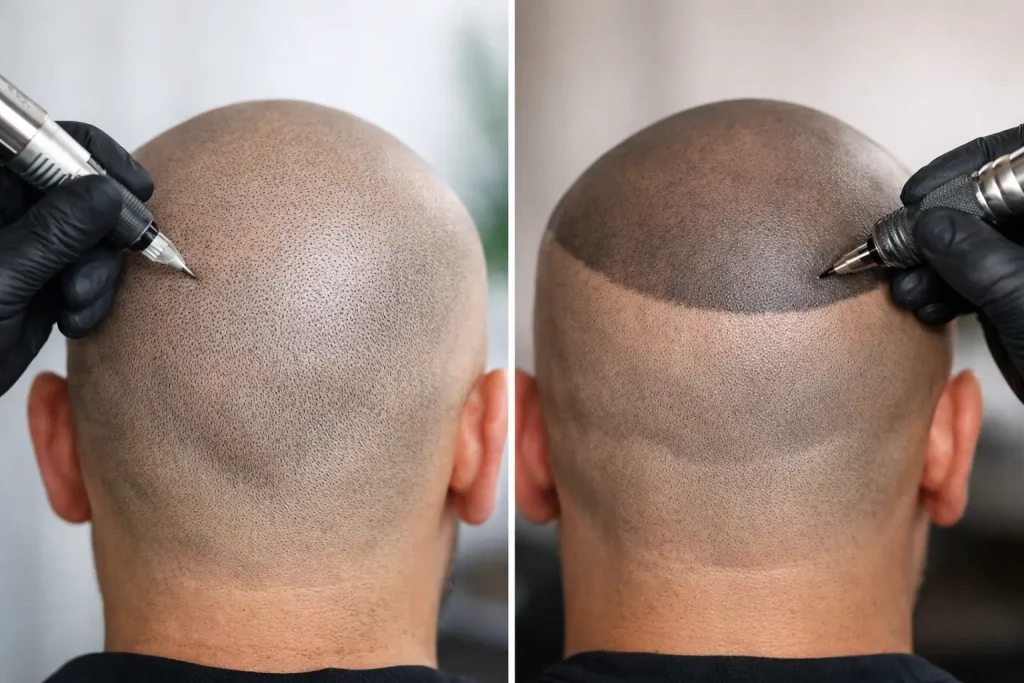
If you’ve been researching hair loss solutions, you’ve probably seen the phrase smp vs scalp tattoo come up again and again. On the surface, they can sound like the same thing. Both involve pigment placed into the scalp. But in practice, they are not interchangeable, and that difference matters when your goal is a natural, believable result that restores confidence rather than drawing attention.
For someone dealing with thinning hair, a receding hairline, transplant scarring, or full hair loss, the wrong assumption can be expensive. A traditional scalp tattoo may be done by a capable tattoo artist, but scalp micropigmentation is a specialized cosmetic procedure built specifically to replicate the look of hair follicles. That distinction affects everything from pigment choice to needle configuration to how the result ages over time.
SMP vs scalp tattoo: the core difference
The simplest way to understand SMP vs scalp tattoo is this: scalp micropigmentation is designed for realism, while a standard tattoo is designed for tattooing. That may sound obvious, but it’s exactly where many people get tripped up.
SMP uses highly controlled impressions to mimic the appearance of shaved follicles or create the illusion of density under existing hair. Every detail is intentional – size, spacing, depth, hairline design, shade matching, and how each point sits against your skin tone and remaining hair. The end goal is not artwork. The end goal is invisibility.
A scalp tattoo, in the traditional sense, is usually performed with methods and materials intended for body art. Even when applied to the scalp, standard tattoo techniques are not automatically optimized for follicle replication. The pigment can spread differently, the impressions may be too large or too saturated, and the final result can look more like ink in the skin than natural hair detail.
Why technique matters so much
On a shaved head or thinning scalp, there is nowhere for poor work to hide. That’s why technique is everything.
Depth changes the result
SMP is performed at a precise, shallow depth to create crisp, soft-edged impressions that resemble real follicles. Go too deep, and the pigment can heal cooler, blur more, or migrate in a way that makes the dots expand. When that happens, the scalp can take on a stamped or overly dark appearance.
Traditional tattooing often works at a different depth because it is meant to create lasting body art, not the optical illusion of tiny follicle points. On the scalp, that difference can completely change how natural the treatment looks.
Impression size is not a small detail
A real follicle is tiny. To recreate it convincingly, the impressions in SMP need to be consistent but not mechanical, subtle but still visible, and scaled to your skin and hair characteristics. If the dots are too large, too dense, or too uniform, the eye picks up the pattern immediately.
This is one of the main reasons elite SMP work stands apart. Precision is not just a technical skill. It is an artistic judgment developed through specialized experience.
Hairline design can make or break it
A natural SMP result does not start with the machine. It starts with the hairline.
In scalp micropigmentation, the hairline is custom-designed based on age, face shape, skin tone, existing hair, and how soft or defined the finish should be. A good hairline does not scream for attention. It looks like it belongs to you.
With a standard scalp tattoo approach, there is often less specialization in age-appropriate hairline design or density transitions. That can lead to harsh fronts, unnatural symmetry, or a look that feels too sharp for the person wearing it.
Pigment in SMP vs scalp tattoo
Pigment choice is another major difference in the SMP vs scalp tattoo conversation.
SMP practitioners use pigments formulated for scalp micropigmentation, with the goal of healing into natural-looking follicle impressions. The focus is on controlled, realistic tones that suit the scalp and avoid obvious color shifts.
Traditional tattoo inks are developed for body art. On the scalp, those inks may age in a less predictable way for cosmetic follicle simulation. Depending on the product and application, they can heal too dark, take on unwanted undertones, or create a look that becomes less believable over time.
This does not mean every body tattoo ink will fail or every SMP pigment will age perfectly. It means the margin for error is much smaller when realism is the entire objective.
The treatment process is different too
Scalp micropigmentation is typically built as a layered process over multiple sessions. That is not just a scheduling preference. It is part of how natural results are created.
In most high-level SMP work, the first session establishes the foundation, the second adds density and refinement, and the third completes the look with balance and detail. This staged approach allows the practitioner to see how the pigment heals, make adjustments, and keep the result controlled rather than overdone.
A traditional tattoo mindset often leans toward finishing as much as possible in one sitting. For scalp work, that can be risky. Hairline restoration and density simulation usually benefit from restraint, healing assessment, and strategic layering.
Who should choose SMP?
If your goal is to look like you have a fuller head of closely shaved hair, stronger density through thinning areas, or camouflage for FUT or FUE scars, SMP is the more precise and purpose-built solution.
It works especially well for men who want the clean shaved-head look without exposing uneven hair loss. It also works for women who want reduced scalp contrast in thinning areas without surgery. For clients with transplant scars, SMP can soften the visibility of linear or dot scarring when done with the right approach.
This is where specialization matters most. Cosmetic realism on the scalp is not a side service. It should be the main discipline.
When people confuse SMP with a scalp tattoo
The confusion usually comes from the fact that both procedures involve implanting pigment into the scalp. But calling them the same is like saying portrait photography and passport photos are the same because both use a camera.
One is built around replication, subtlety, and visual deception in the best sense of the word. The other may still involve skill, but it is not inherently designed for hair loss correction.
That distinction becomes even more important if you are already self-conscious about your appearance. Most clients are not looking for a result that simply exists. They are looking for a result that disappears into their overall look and gives them their confidence back.
What to look for before booking
When comparing providers in the SMP vs scalp tattoo space, do not stop at the words they use. Look at the work closely.
Pay attention to healed results, not just fresh treatment photos. Study the hairlines. Do they look natural at different ages? Are the follicle impressions appropriately sized? Does the density look soft and realistic, or heavy and obvious? If scars are being treated, do they actually blend? If women’s density work is shown, does the scalp contrast appear reduced without creating a hard tattooed effect?
You should also ask about session structure, pigment selection, and how the practitioner approaches different skin types and hair loss patterns. Serious SMP artists have clear systems because the work demands it.
For clients seeking premium-level realism, this is exactly why specialist clinics stand apart. A focused SMP practice such as RK Scalp Micropigmentation is built around natural results, not generalized tattoo application.
The real question is not SMP or tattoo
The real question is whether the treatment was designed for hair loss correction from the ground up.
If you want a cosmetic result that looks like real follicles, blends with your features, and still feels believable up close, scalp micropigmentation is in a different category from a standard scalp tattoo. The tools may seem similar from a distance, but the planning, execution, and outcome are not.
Hair loss already asks enough of your confidence. The solution you choose should give something back. When the work is done with precision, restraint, and a commitment to realism, the best result is simple: people notice you look sharper, younger, and more confident, but they do not notice why.